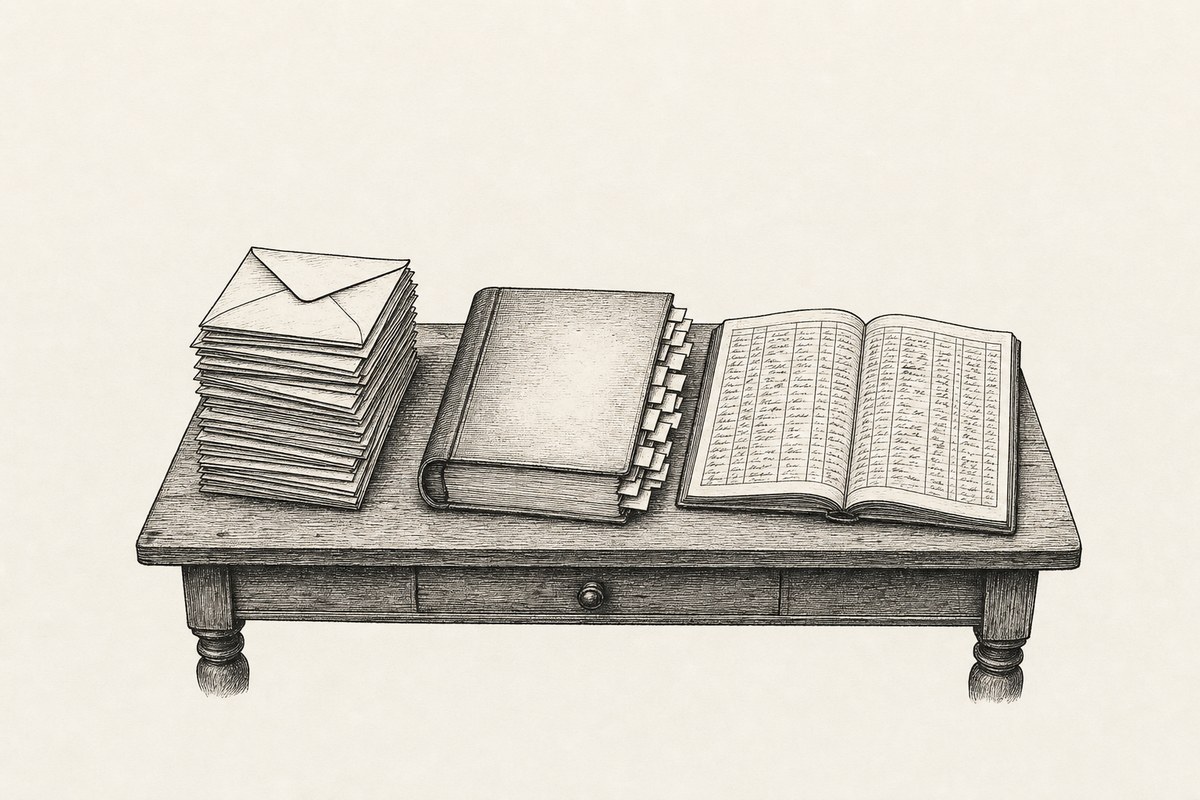
The question I get asked most, for a few years now, goes roughly like this: "So what can AI actually do?" The people asking are usually not technical, and they are tired of the two answers that circulate: everyone's job disappears next year, or this is expensive autocomplete. Both have a point, and neither answers the more practical question: what can I use this for at work tomorrow.
So this article is my attempt at the answer in the middle: what people already use it for every day, what it still gets wrong, who it helps most, and why nothing at your office has probably changed yet. I am keeping the scope to ordinary office work, meaning email, documents, data, and reports. Coding, images, and robots are a different story and I am leaving them out.
For context, I have spent the last few years running a company whose product uses AI, so most of the examples below are things I have watched people do, and some are things I do myself.
As a starting picture, say you arrive this morning with 40 unanswered emails, a 60 page contract to summarise before a two o'clock meeting, and a spreadsheet from a branch office where the city names are spelled twelve different ways. With AI, all three can be done today in about twenty minutes. The results can also be wrong, and you only find out if you check. That is roughly the honest answer to the question in the title, and the rest of this article is examples and explanation.
What it genuinely does
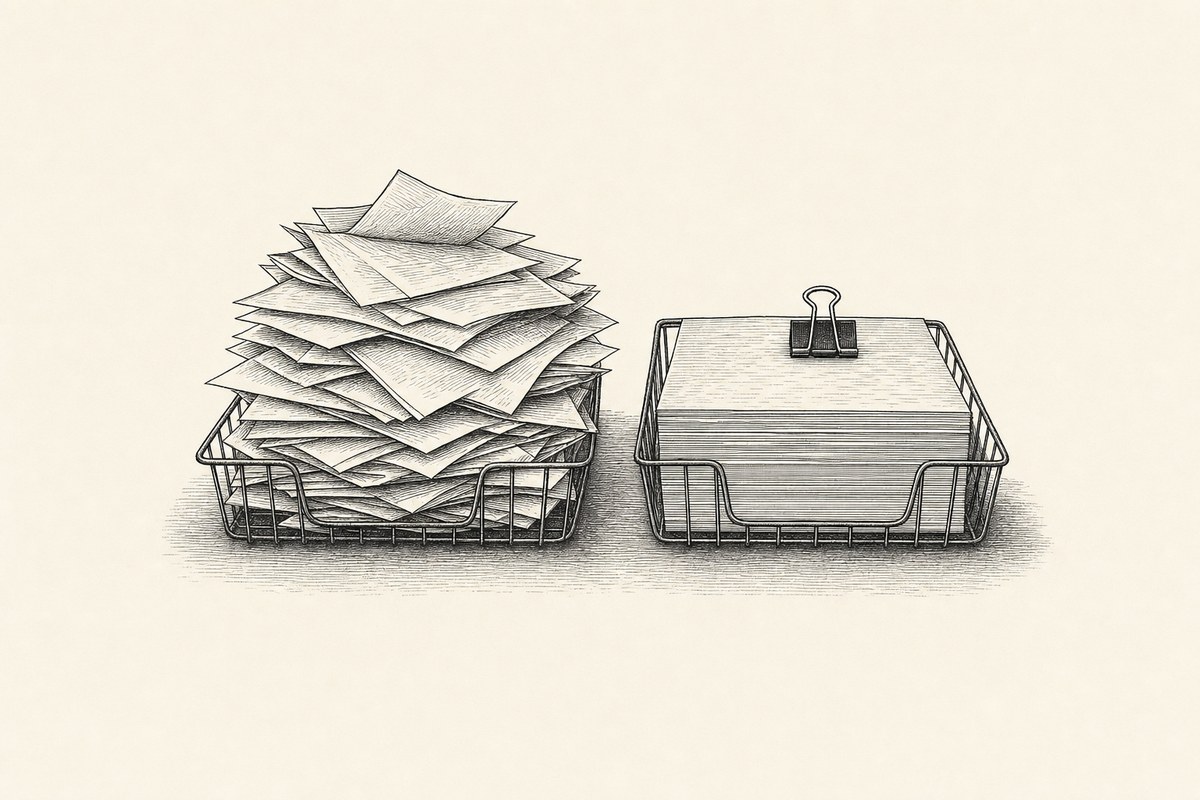
This is not a demo list. It is what people actually hand to AI every day, from the most common use to the one mentioned least.
Reading long things. Contracts, annual reports, notes from a three hour meeting, a pile of survey responses. The result depends almost entirely on the question. Ask it to "summarise this" and you usually get something bland. It becomes useful when the question is specific: which section covers late delivery penalties, who promised what, which numbers changed since last month's version, whether there is a clause that hurts us if we want to walk away halfway through.
Turning a mess into something usable. Meeting notes typed in a hurry, converted into a task list with names and dates. Three thousand rows of inconsistently formatted data, normalised. A recording turned into a transcript, then into themes. Two hundred customer complaints sorted into ten problems. This kind of work usually costs an afternoon, and very few people like doing it.
First drafts. Proposals, difficult emails, replies to complaints, presentation outlines, job descriptions, training material. The output is rarely usable as is, and in my view it should not be used as is. The part that eats the most time, though, is usually starting, and that part does disappear, because there is already a draft to correct. Most of us are far quicker at correcting something than at inventing it.
Explaining things again. Paste the paragraph from IT or legal that you did not follow and ask for it in plain language. Then ask one more thing: if I agree to this, what is the risk to me. This is the most common use I see and the one people mention least, because nobody wants to admit they only half understood a document they signed.
Language. Translation that does not read stiffly, in both directions, with the tone adjusted. The same source material becomes a formal email to a client in Tokyo and a casual Instagram caption. If your work crosses borders, this alone is felt every day.
Thinking out loud with it. This is the least discussed use and in my view the most valuable. You have a decision that is bothering you, you write the situation out at length, and you ask it to build the case for why your plan will fail. The point is to find the weak spots before the plan is presented. The AI does not decide anything here, it only tests.
Why so many people try it and shrug

If you have tried it and came away unimpressed, I can roughly guess what happened: you opened ChatGPT, typed one short sentence, got back something that sounded tidy and said nothing, and closed the tab thinking "is that it?"
In my view the problem is in how we treat it. Most people use AI like a search engine: one short question, hoping for one correct answer. It behaves much more like an intern who is fast, tireless, willing, started this morning, and therefore knows nothing about your office.
You would not tell a new intern to "write the proposal" and send the result straight to a client. You would give them context first: a proposal that worked last time, who the client is, what they care about, the format your company uses. Then you would correct it once or twice. Treat AI the same way and the output changes completely. Three things matter most:
- Material. Paste the actual document, an example of output you consider good, the raw data. It cannot guess what is in your head.
- Context. Who it is for, who will read it, what tone, what length, what to avoid.
- A second pass. The first answer is raw material. Say which part is weak and ask for a fix. Two or three rounds is normal.
A simple example. "Write a follow up email to the client" will almost certainly produce something generic that anyone could have sent. Compare it with this: here is the client's last email, here is what I replied two weeks ago, here is what I actually want, write a follow up that stays polite but makes clear we need a decision this week. The tool and the minute are the same, and the output is very different, because the material and context are different. It sounds trivial, and in my view it is roughly the whole difference between people who find AI unremarkable and people who will not go back.
A prompt is the instruction or question you type into the AI, together with whatever material and context you attach to it.
What it still gets wrong
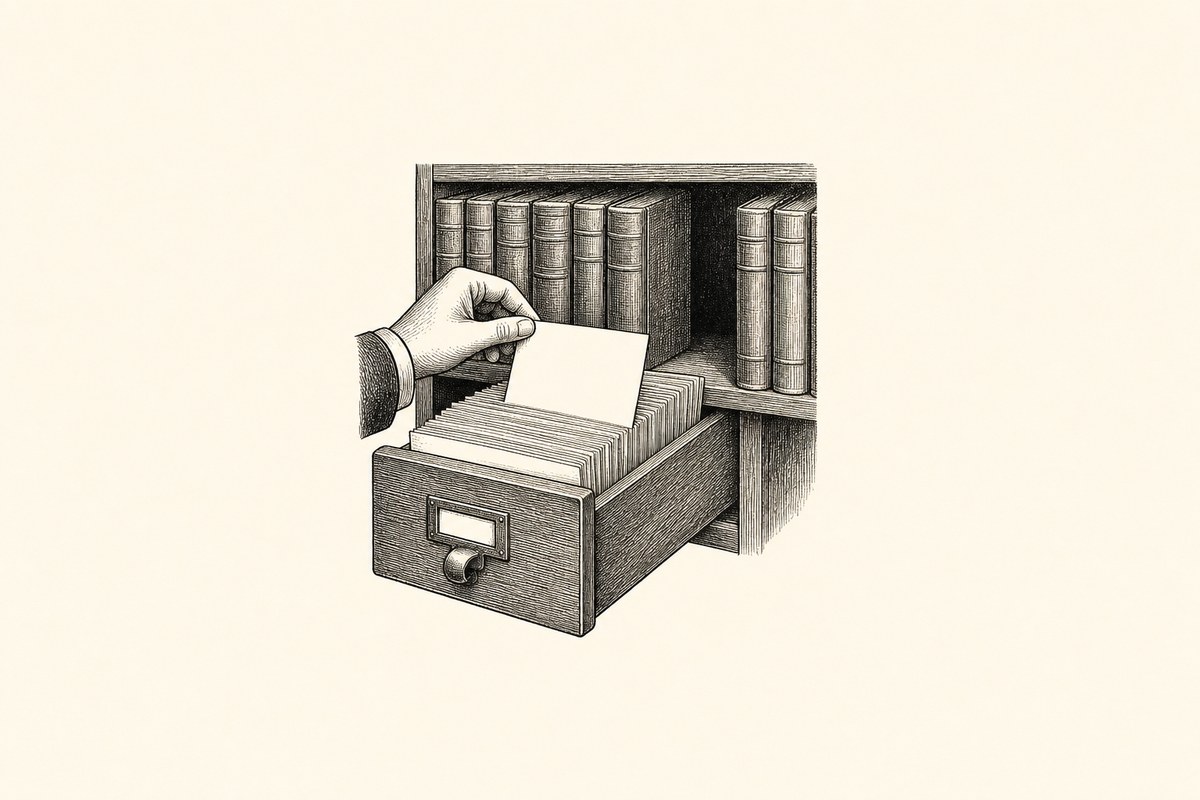
Numbers and sources. This is the dangerous one, precisely because it is the most convincing. Ask for data or references and it will produce them complete with a plausible title, an author who really exists, and a year that fits. One study asked thirteen AI models for hundreds of thousands of academic references. About half of them did not exist, meaning the papers were never written by anyone.[1] My working rule is simple: anything that looks like a number, a name, a date, or a quotation is wrong until you open the source yourself.
Your office context. It does not know the client already complained twice last month. It does not know the person you mentioned is on leave. It does not know why that project was paused, let alone that the reason is political and should not be written down anywhere. It knows what you pasted into the chat, and nothing else.
It tends to agree with you. This gets discussed least and causes the most trouble. Tell it your plan is good and it will tend to agree. Flip the question to "why will this plan fail" and it will argue that just as convincingly. So in my view it should not be used as a judge. It is more useful when you ask it to look for weaknesses in your plan and then decide for yourself which ones are valid.
Anything that carries responsibility. There are paid AI products built for specific professions by large companies that genuinely know the field. When tested independently, even those returned wrong answers on a share of the questions. If a product that specialised still misses, a decision you personally have to answer for should not yet be handed to a general chatbot.
Who it helps most
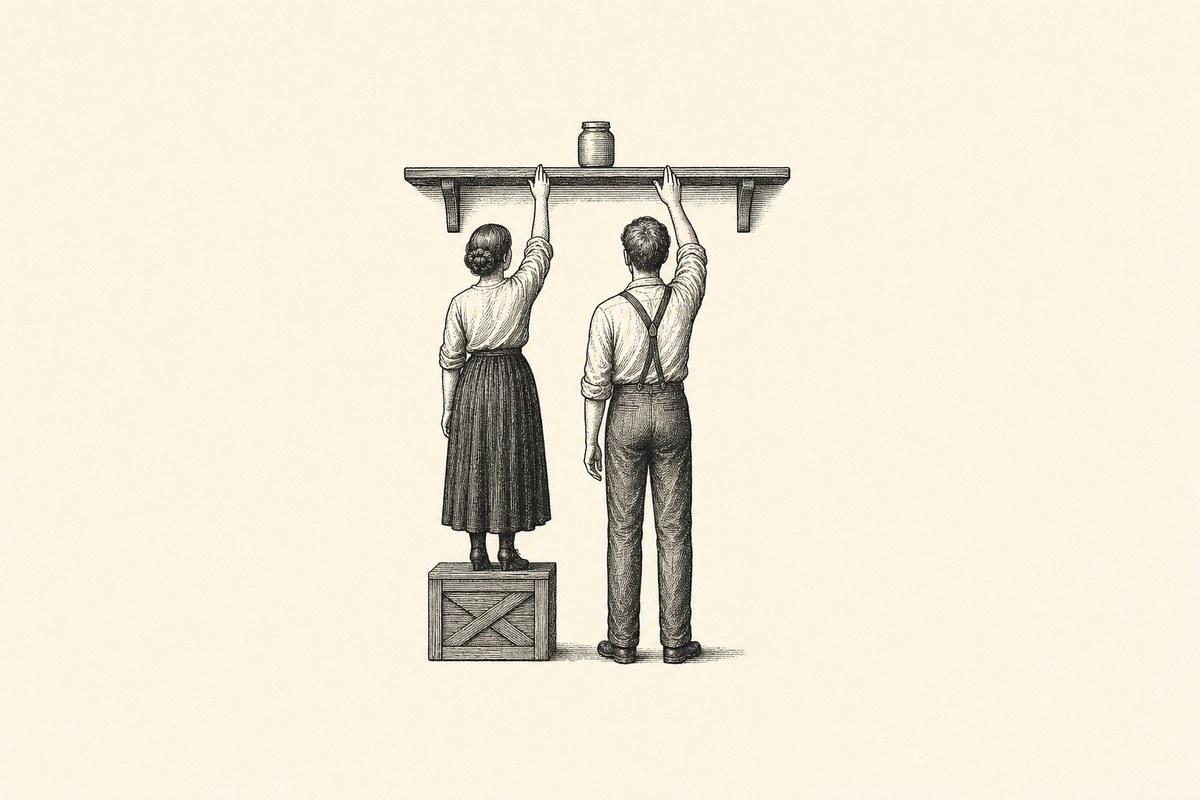
This is the part people discuss least, and in my view the part that matters most.
There is one study with unusually good data. A software company gave AI assistants to 5,172 of its customer support agents, and a full year of the resulting data was studied by economists at Stanford and MIT.[2] The newest agents, who normally took longest to resolve a complaint, became about 36 percent faster. The most senior agents, who were already good, barely changed. New staff with AI resolved as many complaints as staff who had been in the job for months.
That makes sense to me. Experienced people mostly hold patterns: which sentence calms an angry customer, which order of checks finds the problem fastest, when to escalate. Patterns like that are exactly what a machine learns most easily. What is hard to copy is the knowledge that lives in nobody's notes, such as knowing this client is sensitive about price because of a bad experience last year.
So if writing a clean email is easy for you, ChatGPT does not feel like much help. If you still rewrite the same paragraph for half an hour, the help feels large. Both are right, because they start from different places.
There is one thing in the 36 percent figure that is easy to misread, though. The study measured a task with a clear ceiling: closing one customer complaint. However fast you get, one ticket is still one ticket, so it is no surprise that people who were already good could not climb much higher there.
Open ended work is a different story: writing strategy, designing, planning a campaign, drafting a proposal. AI is very good at producing options and very poor at choosing between them. It will hand you ten versions in five minutes. Seeing that version seven is the right one and the other nine are poor takes someone who already has a standard for what good looks like, which is the judgment and taste built up over years.
That is exactly what a senior person brings. So if you are senior and AI feels unremarkable, the most likely explanation is that you are still using it only to type faster. The difference appears when you point it somewhere else: the work you keep postponing because it takes too long, five versions of a strategy built at once and compared, the dataset nobody ever had time to open, the prototype that normally waits in another team's queue. There the number can go far past 36 percent.
So both are true: people starting out quickly become decent, and people who are already good can climb much higher, provided they are willing to change how they work.
"My job probably isn't affected"
The reaction I hear most often goes roughly: "my job isn't really affected, so I'm not worried." I understand why. If your work is meeting people, negotiating, being on site, or running a team, there is no AI that replaces that, and there still isn't.
But take the job apart first. Almost no job is one activity. It is usually dozens, and only two or three of them are what you are genuinely paid for. The rest is supporting work: reports, emails, meeting notes, summaries, documents, explaining things to other people. The cost of that supporting work is what has just dropped. Look at any industry and the pattern is the same:
- Restaurants. Replying to reviews, building shift rosters, working out food cost, training material for new staff, menu descriptions.
- Construction. Daily site reports, vendor correspondence, tender documents, progress summaries, site meeting notes.
- Clinics. Referral letters, record summaries, patient education material, insurance claim paperwork.
- Schools. Exam questions, report card comments, lesson material, letters to parents.
- Retail. Product descriptions, replying to customer messages, weekly sales summaries.
- Factories. Standard operating procedures, production reports, incident write ups, audit paperwork.
None of those is called an "AI job". All of them contain a pile of reading, writing, tidying, and checking. In every industry there is a part that needs someone to think: something has to be read until it is understood, weighed before it is decided, explained again to somebody else in different words. That part used to be expensive, because only trained people could do it, and trained people are in limited supply. Most of that reading, writing, and summarising can now be done with an AI subscription that costs far less than one salary.
So your job is not necessarily going anywhere. What is more likely is that the person beside you doing the same work now has an extra hour every week. Or your junior, who used to need two years to reach your level, now needs one. If you feel your job is safe, you are probably right. In my view the reason is still worth checking, by taking the job apart as above.
If it is that good, why does nothing feel different?

Because the saving is still small, and it disappears into the working day.
Denmark measured this carefully: 25,000 workers in the eleven occupations most exposed to AI, linked to official payroll records.[3] On average they saved 2.8 percent of their working time. On a 40 hour week, 2.8 percent of 40 is 1.1 hours, roughly an hour a week. The effect on pay and hours worked was zero. An hour a week is real, and it is too small to show up in pay or in headcount.
My guess at the reason is simple. Most of us use it for small self contained jobs: one email, one summary, one draft. The time saved is absorbed straight back into meetings, notifications, and whatever else was already queued. Not a single step of the work is actually removed. The weekly meeting still happens. The report is still produced in the same format, read by the same people, approved through the same chain. The only change is that the report is finished faster.
The teams that genuinely feel a difference have usually done the more uncomfortable thing first, which is to sit down and ask which steps no longer need to exist. That is a political question more than a technical one, and in my view that is exactly why it gets asked so rarely.
Does it actually matter?
For this question I keep going back to one story from the history of electricity.
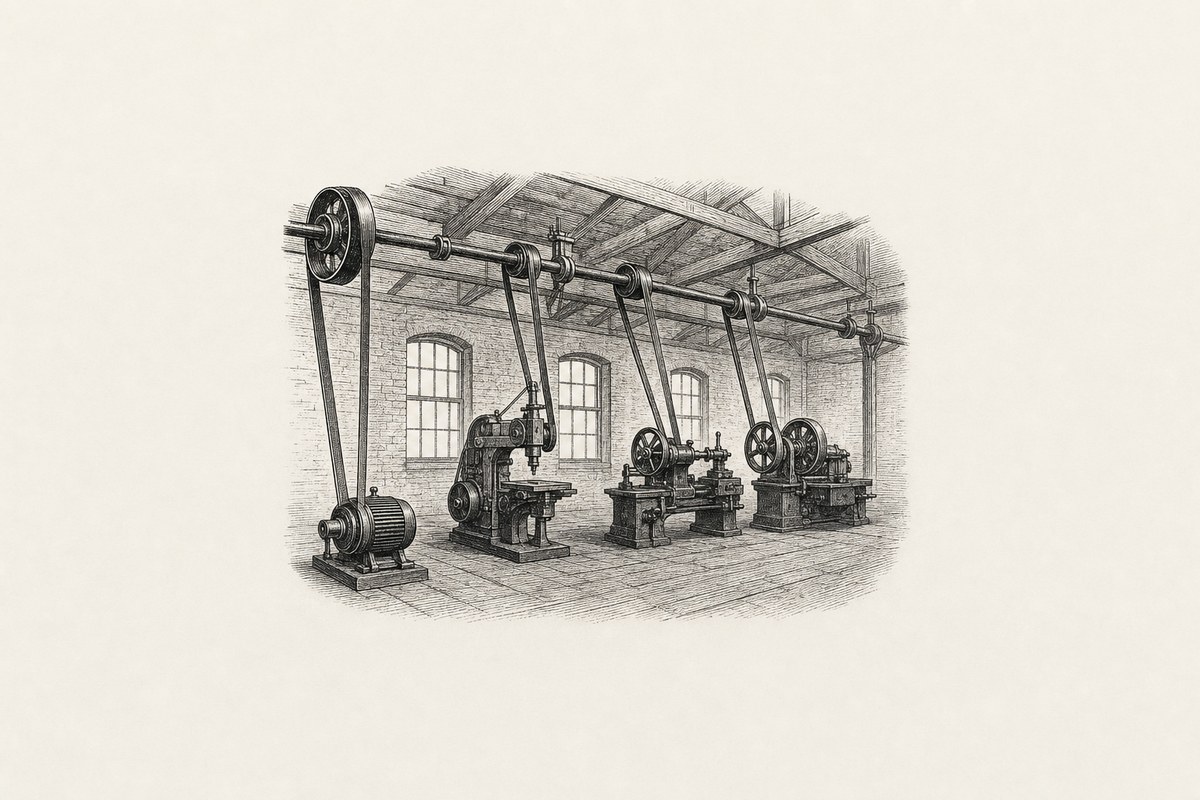
In 1882 Edison switched on his first commercial power station in New York. Seventeen years later, in 1899, electric motors still drove less than 5 percent of the machinery in American factories.[4] The problem was the factory. A single large steam engine turned one long shaft along the ceiling, and every machine on the floor hung off that shaft by a belt, so every machine had to stand near the shaft, and the order of the machines followed the shaft instead of the order of the work.
When electricity arrived, factories pulled out the steam engine and bolted a large electric motor into exactly the same spot. The shaft and the belts stayed where they were. The power source was new, the layout of the factory was the old one, and output barely changed.
It took about another twenty years for people to notice that if every machine had its own motor, machines could go anywhere. The floor could be laid out around the order of the work, walls could move, and roofs could open, because no shaft had to hang from them. Once factories were rearranged, productivity growth in American manufacturing more than doubled, from 1.3 percent a year before 1919 to 3.1 percent after.[4] Counted from the first power station in 1882, that is 37 years, and most of that time went on one thing: fitting new machines into an old frame.
In my view we are still at the stage of pulling out the steam engine. AI is used to speed up steps that already exist, which is reasonable, because that is the easiest and least painful thing to do with it. ChatGPT opened to the public in November 2022, so we are roughly four years in. So my answer to "does it actually matter" is yes, slowly, and without a single big announcement. What changes first is usually small, until somebody rearranges the factory floor and the gap becomes visible.
Try it yourself this week
The fastest way to stop guessing is to try it yourself. This is what I suggest to anyone who asks:
- Pick one job you dislike. Something repetitive, time consuming, and not a big decision: cleaning up data, summarising a long document, turning meeting notes into a task list, writing the first draft you keep putting off.
- Give it material, and not only an instruction. Paste the actual document. Paste an example of output you think is good. Say who will read it and what it is for.
- Do not stop at the first answer. Say which part is weak and ask for a fix. Two or three rounds is normal, and the second round is usually where it starts to look good.
- Check the output line by line, once, properly. Numbers, names, and dates especially. If something is off, you now know where the limit is. If nothing is off, you know that too.
Do that once, seriously, and you will have your own answer to the question in the title. An answer from your own experience is usually more convincing than anyone else's opinion, mine included.
That is my view of what AI can actually do today. Much of this is simplified, and everyone's job is different. If this article gets enough response, I may write a follow up on how to give AI the context it needs so the output stops being generic.