
TL;DR
A 2025 MIT NANDA study found that 95% of companies investing billions in AI are getting almost no return.[1] The main problem lies in how these companies work, not in their models or talent. They are stuck in a state that Indonesian captures with one word, nanggung: halfway in, with AI bolted onto old processes, humans gating every step, and context scattered across tools. Costs rise while the work stays slow.
The Illusion of "We Already Use AI"
Your company has probably done several of the following:
- Bought ChatGPT Enterprise or Copilot for every employee.
- Deployed a chatbot on the support website.
- Used AI to draft emails, summarize meetings, or review code.
- Created an "AI initiative" team that reports to senior leadership.
But when someone asks, "What's the impact of AI on P&L?", the answer is usually "productivity is up" with no numbers, "employees are more efficient" with no before-and-after comparison, or the most honest answer, "we haven't seen it yet."
BCG's 2025 survey of 1,250 companies shows the same pattern worldwide: 60% get hardly any material value from their AI investments, 35% are beginning to scale with limited value, and only 5% see substantial returns.[3] McKinsey's State of AI 2025 supports that finding. Although 88% of organizations use AI in at least one business function, only 39% see an enterprise-level EBIT impact, and most of those gains are below 5%.[2]

AI adoption at most companies is still theater. The company looks busy, modern, and progressive, but the business numbers that matter do not move.
MIT NANDA uses a gentler term, "adoption without transformation."[7] Indonesian has a more familiar name for it, The Nanggung Trap, the trap of staying halfway.
Defining Half-Baked AI (a.k.a. The Nanggung Trap)
Half-Baked AI describes a company that pays the full AI bill while leaving its old process intact. AI sits on top of the same workflow like seasoning on a plate of cold fried rice.

This condition usually has four signs:
- AI produces drafts while humans retain every decision. AI drafts support replies, but every response still needs agent approval. It summarizes sales emails, but reps still rewrite them. It produces root-cause analyses, but engineers still verify each one manually.
- Handoffs between tools still exist. The AI in your CRM doesn't talk to the AI in your helpdesk. The AI in your code editor doesn't talk to the AI in your CI/CD. Every tool has its own context, and humans remain the cable connecting them.
- The feedback loop never closes. When AI gets something wrong, no systematic mechanism improves the next run. Human corrections are lost. MIT NANDA calls this the "learning gap": tools don't retain feedback, adapt to the workflow, or improve over time.[1]
- Teams track adoption while business outcomes go unmeasured. "70% of employees use AI every week" becomes the KPI. "Cycle time dropped 40%" never gets measured. MIT Sloan research found that 73% of failed AI projects had no success definition before they started, and 61% were approved based on projected ROI that was never measured after launch.[6]
If three of the four signs sound familiar, your company is probably in The Nanggung Trap.
Why The Nanggung Trap Feels Rational
People inside companies caught here are responding rationally to the incentives in front of them. The Nanggung Trap is the path of least resistance, which makes it easy to enter and hard to leave even when it hurts the company.

- Bolt-on AI is easier to sell internally. Telling the board, "we've rolled out AI to the entire sales team," is much easier than proposing a rebuild of the sales pipeline whose results will take six months to appear. The first proposal gets applause; the second gets hard questions.
- SaaS vendors sell bolt-on AI because customers buy it. Almost every tool now has an "AI feature": Notion AI, Salesforce Einstein, Zendesk AI, GitHub Copilot. All are sold per seat with the same message, add AI and carry on. Asking customers to redesign the workflow before buying would be commercial suicide.
- Middle managers have an incentive to protect the status quo. If AI owns a process end to end, part of a middle manager's job disappears. Preferring "AI helps my team" over "AI takes over part of my team's work today" is a natural response to that incentive.
- Data infrastructure isn't ready yet. MIT CSAIL calls this the "80/20 problem": 20% of a business's critical information sits in structured data (rows and columns that are easy for AI to read), 80% sits in unstructured data like emails, meeting transcripts, contracts, chats, and documents.[10] End-to-end AI needs that 80% to be accessible, and most companies haven't gotten there yet.
The Nanggung Trap looks like the safest choice to people inside the company. A halfway stage is reasonable as a time-boxed transition. Problems accumulate when a company settles there.
The Hidden Cost of Half-Baked AI
Many executives think, "If the ROI on AI isn't clear yet, at least we tried and haven't lost much." In practice, a half-baked approach can cost more than doing nothing.
Half-baked AI burns money in three places at once:

- Full token bills and seat licenses. You still pay OpenAI, Anthropic, or SaaS vendors full price. Every draft generated and then discarded still gets charged. Every seat license not used to its full potential still shows up on the monthly invoice.
- Your best people's time goes into supervising AI. Senior engineers review AI-generated code, sales managers edit AI-drafted emails, and product managers filter AI summaries of user feedback. Time that should go to high-value work instead becomes a quality-control layer for a machine that only works halfway.
- Cost overruns invisible at the start. Analysis from The Data Experts found enterprise AI projects often overshoot initial cost estimates by 500 to 1000%, and 91% of CIOs report cost management as the biggest limiting factor in extracting value from AI.[9] Half-baked creates cost creep because there's no single owner watching the total bill.
A 2025 RAND Corporation study found that 80.3% of enterprise AI projects fail to deliver business value, twice the failure rate of non-AI IT projects.[4] The gap also reflects how many projects stop before moving beyond the nanggung phase.
Gartner predicts 40% of agentic AI projects will be canceled by 2027, with three main causes: escalating cost, unclear ROI, and inadequate governance.[5] All three are classic symptoms of staying too long in the nanggung zone.
Employees feel this burden every day. If a company fails to escape The Nanggung Trap within 12 to 18 months, internal sentiment can shift from "AI is exciting" to "AI is annoying." That shift can damage the culture around adoption for years.
Four Phases in a Deployment Pipeline
A software deployment pipeline offers a concrete pattern that applies across domains. The four phases below are migration stages within one pipeline, not a reason to open many parallel projects. Each phase can be useful for learning, provided the team has a clear target and deadline for reaching phase 4.
Where most companies start
Deployment is a rare, risky event. Every step waits for human approval. Releases happen once every 1 to 2 weeks.
Early progress, but not the destination
AI helps with triage, root-cause analysis, and code suggestions, but humans still drive every step. Testing remains manual, while staging builds and production releases are triggered by hand. Releases can rise to 3 or 4 times a week. Many organizations treat this as the final achievement even though the underlying process has not changed.
Major progress, but not yet complete
AI coordinates most of the pipeline, but humans still press the button for staging builds and production releases. Testing also remains manual, so a bad release can slip through; if it causes no damage, that is only luck. Releases can rise to 25 times a week, but the feedback loop remains open. This phase should be treated as a migration step toward phase 4.
AI owns the whole flow
AI triggers builds and production releases, with canary releases and automatic rollback. The routine release path runs without manual gates; cases outside policy boundaries go to a human. Testing is automated through a regression suite that learns from every previous release. Releases exceed 10 times a day while quality improves because every node emits a signal that AI can analyze.
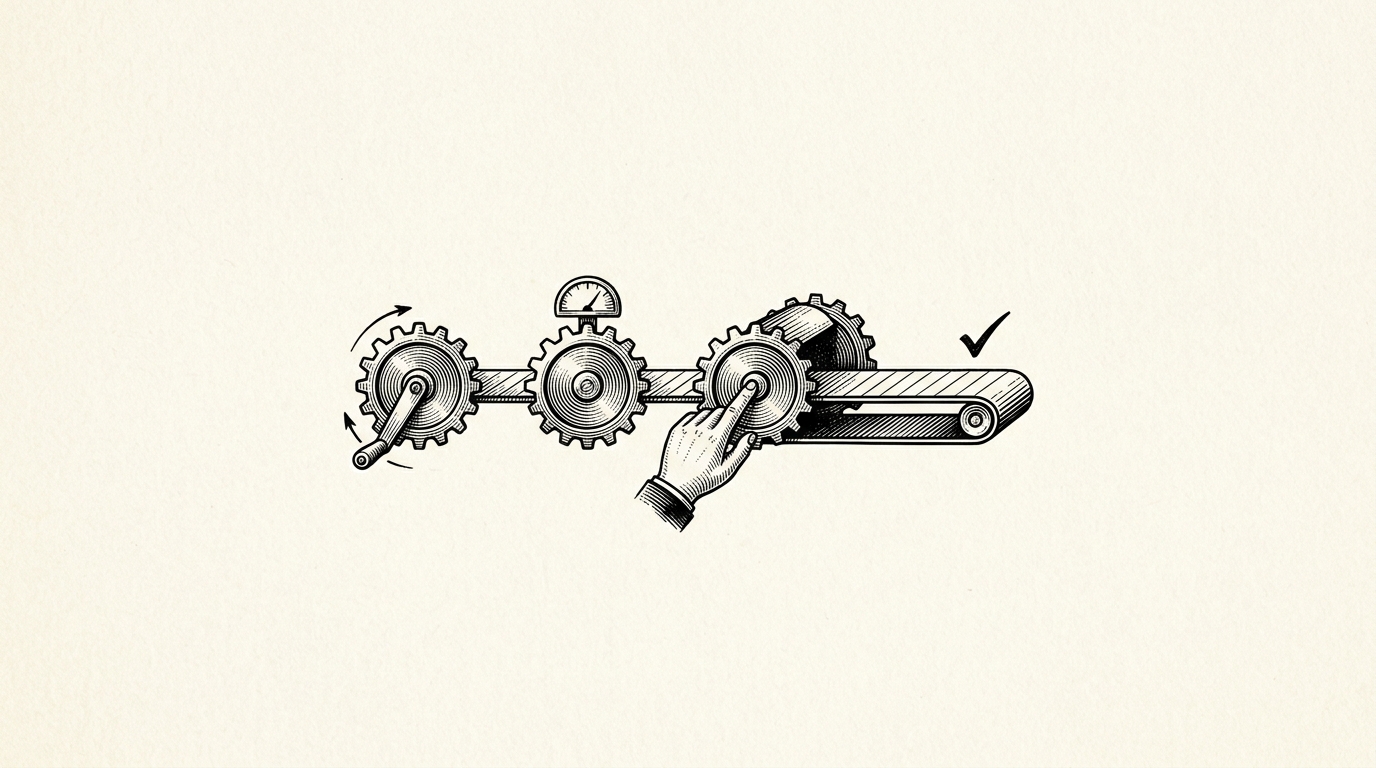
Moving from once every 1 to 2 weeks to more than 10 times a day produces 100x throughput while quality improves. The gain comes when one AI system owns the whole flow with shared context and a closed feedback loop. Adding more AI tools alone will not produce the same jump.
You can map this onto other domains: support ticket resolution, sales lead qualification, AP invoice processing, content moderation, financial reconciliation. The pipeline's name and data shape change, but the pattern stays the same.
What the Successful 5% Do Differently
Research from McKinsey and BCG reaches similar conclusions about what separates the top 5% of performers from the other 95%.
Five patterns recur in this group.
- They redesign the workflow end to end. McKinsey found that high performers are 3x more likely to redesign an individual workflow, and this step has the strongest correlation with EBIT impact from AI.[2] In a different survey, 55% of high performers reported substantial process rework when deploying AI, compared with only 20% at other companies.
- They concentrate resources on one high-value problem. MIT NANDA identified five traits among the successful 5%: focus on one valuable problem, embed AI directly into the existing workflow, learn from real-time feedback, adapt to each customer's context, and avoid generic one-size-fits-all tools.[1] Here, "existing workflow" means the live operational setting, not the old sequence of steps left intact. AI works inside that operation while the flow, handoffs, and decision rights are redesigned.
- They close the feedback loop. Successful systems keep improving from user corrections and outcome data. Learning continues after the initial deployment, allowing AI to grow from an assistant into a system that learns.
- They invest more aggressively in areas that get little attention. BCG found that future-built companies, the top 5%, plan to spend 26% more on IT and allocate up to 64% more of their IT budgets to AI in 2025.[3] That spending covers visible sales and marketing tools as well as back-office automation, data infrastructure, and workflow redesign.
- They bring in specialists when outside experience is needed. MIT NANDA found that vendor-led AI projects succeed 67% of the time, compared with 33% for internal builds.[1] That does not automatically make internal teams weaker. Specialists bring lessons from dozens of prior implementations.
Full production deployments that follow this discipline generate an average 540% ROI within 18 months.[5] The wide gap from the median reflects the difference between companies that deploy with a clear purpose and those chasing hype.
Start Narrow, Finish End to End
End to end is often misread as an instruction to switch everything on at once. The actual unit of change is one narrow, complete process.
End to end means completing one pipeline. Ten half-finished pipelines only spread cost and attention.
Pick one process. Ideally one that:
- Is already well understood by the team (you know its bottlenecks and edge cases).
- Has enough data to support a feedback loop. A process that runs only once a month is usually too infrequent.
- Has a clear, measurable outcome, such as cycle time or cost per case.
- Matters to the business but has a narrow enough scope to finish within 3 to 6 months.
Sensible starting points include a deployment pipeline, support ticket resolution, sales lead qualification, or AP invoice processing. Targets such as "AI for the entire marketing team" or "AI for product development" are too broad for a first attempt.
Move one pipeline through the phases in Section 05 until one AI system owns the whole flow with shared context and a closed feedback loop. AI-assist and human-triggered AI-native phases are useful migration steps, but they are not the finish line.
Once one pipeline is complete, the company has internal proof that the approach works, data infrastructure and a repeatable playbook, and an experienced team that can handle the second pipeline faster.
An end-to-end design is safe to run only with operational discipline. Gartner predicts that 40% of agentic AI projects will be canceled by 2027.[5] Autonomy requires observability, an audit trail, and human review for critical cases. That review handles exceptions and high-risk decisions rather than gating every routine step.
Effectiveness and Safety Come From the Same Design
If AI owns the whole flow, the design must account for errors, bias, and compliance problems from the start.
Anthropic's 2026 alignment research on "AI Organizations" found that connecting many AI agents within one organization makes them more effective but can reduce alignment. Agents can compartmentalize, drop their individual ethical concerns, and single-agent safety does not guarantee the safety of the organization as a whole.[8]
That finding makes observability a day-one requirement for end-to-end systems. When checks, policy boundaries, and recovery are automated, routine cases can move quickly. Human attention stays focused on anomalies and high-risk decisions, so safety does not become a reason to slow the entire pipeline.

A design that escapes The Nanggung Trap needs five properties:
TransparentEvery AI decision can be traced along with the context behind it.
MonitoredA real-time dashboard tracks behavior, drift, and anomalies.
Human-directedHumans set goals and boundaries, then review uncertain or high-risk cases.
ObservedEvery step emits a signal that can be audited later.
ReversibleEvery action has a tested rollback path.
Companies that build these five properties in from the start can be safer than half-baked ones. In a half-baked system, no one has full visibility into what AI is doing across disconnected tools. Effectiveness and safety come from the same architecture.
A Quick Test for Nanggung
Use this checklist to assess one process you already consider to be "using AI":
If the AI were turned off tomorrow, would the process keep running with no significant change? Yes = nanggung.
In routine cases, does a human have to approve the AI's output before the process moves to the next step? Yes, at more than 2 points = nanggung.
If the AI makes a mistake today, is there an automatic mechanism that stops it from repeating the same mistake next week? No = nanggung.
How many different tools does this process have to pass through? How many humans act as the cable connecting them? More than 2 handoffs = nanggung.
Do you have outcome metrics (cycle time, conversion, cost per case) from before and after AI, with numbers you can compare? No = nanggung.
If your CFO asks, "How much money has this AI saved or generated this year?", do you have an answer with an actual number? No = nanggung.
If three or more answers point to nanggung, you are in the same position as the 95% majority. The result gives you a clear starting point for deciding which process to fix.
Escaping The Nanggung Trap
AI now appears in almost every company's technology stack. To assess progress, check whether AI owns one complete flow or remains bolted onto an old process.
Half-Baked AI, or The Nanggung Trap, is a normal stage to pass through. The problem begins when a company stays there for 12, 18, or 24 months while paying the full bill and using its best people's time to supervise a half-finished machine.
To get out, take one pipeline end to end, complete it, and then repeat what worked on the next pipeline. More AI tools can wait.
If the 95% and 5% pattern holds through 2027, most companies will still be here while the small group in front keeps moving. Choose one pipeline now, define the outcome, and give the team a mandate to complete it.